In-Play NBA Prop Betting in the UK — Live Markets and Reaction Windows
 Available in US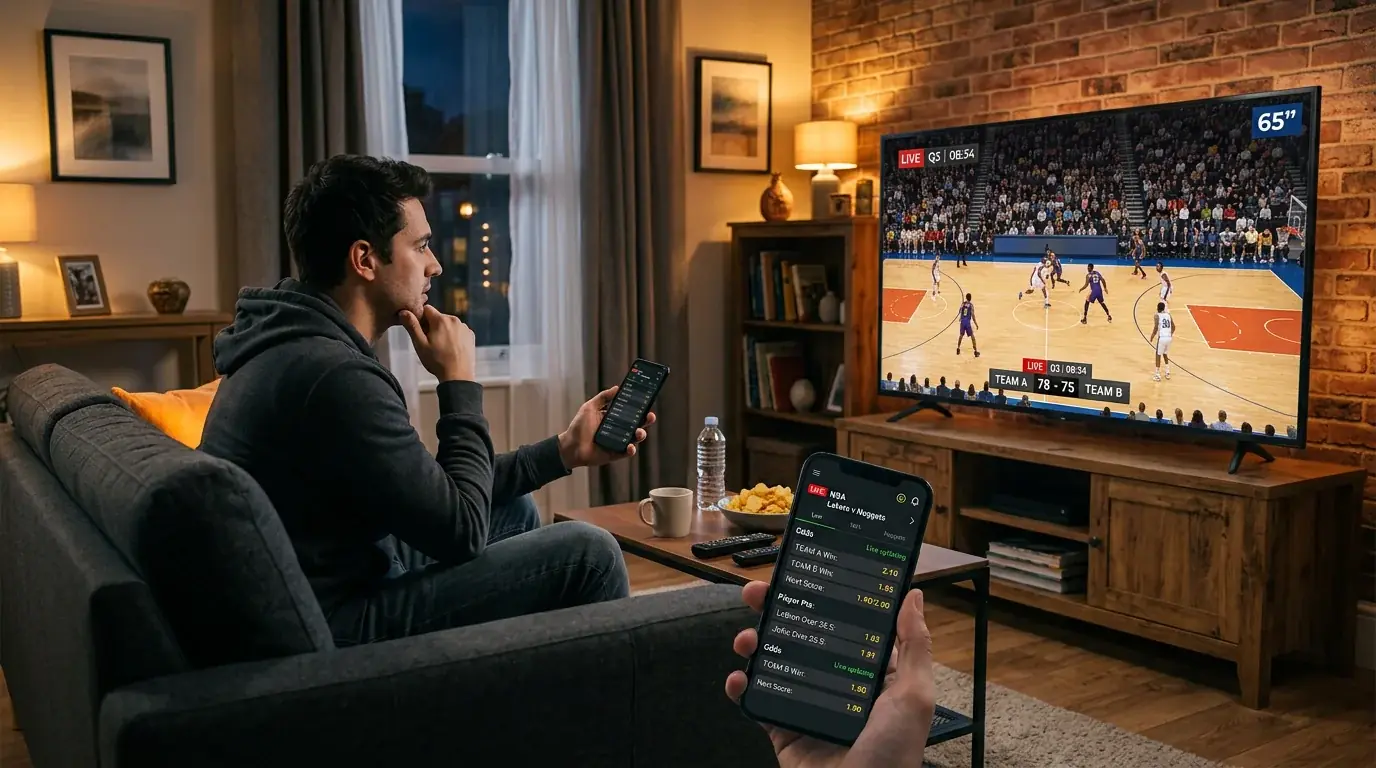
The first time I tried in-play NBA prop betting properly was a Christmas Day Warriors game that started at one in the morning UK time. I had read the pre-match wrong and was bored watching it slip away. Twenty minutes in, the live points line on a Golden State wing dropped by three because he had picked up two early fouls — and the moment those fouls came off the books had not yet repriced. I took the under for the first time at value, watched it cash, and started taking the live market seriously the next week. In-play is where the lag between information and price is widest, and lag is where edge lives.
What stays live once tip-off happens
UK bookmakers run a smaller live prop menu than the pre-match menu, but the core categories all stay open through tip-off. The big four — points, rebounds, assists, three-pointers — refresh continuously, with new lines published as the game develops. Combined markets like PRA stay live at most operators, although a handful drop them into the second half only.
What gets pulled at tip-off, or shortly after, are the specialty markets that depend on a fixed pre-game state. First basket props die the moment the first basket is scored. Some race-to-X markets close once one player has a meaningful lead in the relevant category. Player-versus-player head-to-heads tend to remain open but with widened margins. Alt-line versions of the standard markets are usually thinner in-play, with fewer alternative lines posted and wider spreads between the available ones.
Real-event betting drove a sizable chunk of UK online activity through 2025, with quarterly online real-event betting GGY hitting £508 million in one recent quarter at a 12 per cent year-on-year increase. NBA is a small slice of that, but the in-play menu has deepened steadily as UK operators have invested in the basketball product. The number of live prop markets per game on a typical UK book has roughly doubled in the last three seasons.
The live prop types worth your attention
Not every live prop is worth a serious look. The market efficiency varies dramatically by category, and knowing where the books are sharp versus where they are slow is half the in-play game.
Live points props are the most efficient market on the live menu. The line repriced every couple of minutes based on the player’s running total, his minutes pace, and the time remaining. Books update points lines fast because points props are the highest-volume market and the algorithms are heavily tuned. Edges here are small, and they tend to come from situational reads — foul trouble, a hot shooting hand, a defensive matchup change after a substitution.
Live rebounds and assists props move slower. The volume is lower, the algorithms are less aggressive, and there is a real lag between in-game events and price adjustments. A point guard who picks up four assists in the first quarter sees his live assists line stretch, but the stretch usually trails the actual rate. If you have decided he is going to keep distributing through the third quarter, the live over price beats the pre-match equivalent more often than not.
Live threes props are volatile. Three-point production is streaky, and books over-react to the first two attempts in either direction. A wing who misses his first three threes will see his line drop fast — sometimes more than the underlying rate justifies, because the book’s algorithm is treating the misses as a sustained cooling rather than a normal slump. That over-reaction is the gap to attack.
Live blocks and steals are the niche corner. Volume is thin, lines are coarse, and pricing can lag by minutes after a relevant event. A defender with three steals in 14 minutes will sometimes see his live steals line update slowly, and a sharp punter with a feel for the game can grab value before the algorithm catches up. The flip side: books restrict size on these markets, and large stakes are often refused or partially honoured. Across a typical NBA night UK operators publish roughly two to three hundred individual prop lines, and the bulk of those refresh in-play, but only a fraction are markets where you should reasonably expect to find a live edge.
Reaction windows, suspensions and the rhythm of the live book
Live NBA props operate on a rhythm. Knowing the rhythm changes how you bet.
The book suspends the market briefly after most made baskets, after fouls that send a player to the line, and after timeouts. Suspensions usually last five to fifteen seconds, which is the algorithm’s window to recompute the implied probabilities and republish prices. During those windows you cannot place a bet, but you can pre-load a slip and submit it the moment the market reopens. The first few seconds after a reopening are when the price is freshest and the public has not yet pushed it around — that is often the cleanest spot to take value if you have spotted it.
Longer suspensions happen around timeouts, end-of-quarter breaks, and any meaningful injury event. A player going down to the floor and remaining there triggers an immediate suspension on every market involving him, and the suspension typically lasts until the broadcast confirms whether he is returning. UK operators with strong basketball products often resume markets faster than US books because their algorithms are tuned for a smaller volume and lighter risk profile, but the gap has narrowed in the last two seasons.
The biggest reaction windows happen around foul trouble. A star picking up his fourth foul in the third quarter is a guaranteed minute reduction, and his points and assists props should reprice immediately. The book’s algorithm catches this, but not always at full magnitude — some operators only partially adjust because they are uncertain how aggressively the coach will rest him. If you have a feel for the coaching tendency, the lag is exploitable.
End-of-quarter is a structural window. Rotation patterns are predictable: coaches tend to bring stars back at specific points in the second and third quarters. The market knows this, but the line moves are mechanical and not always aligned with the specific game’s flow. A team blowing the doors off an opponent might sit its star for the entire fourth quarter, and the live prop lines on that star should already reflect a low fourth-quarter expectation by the time the third-quarter buzzer goes.
Streaming and the UK availability picture
Live betting is most effective when you can actually see the game. UK availability for NBA streaming on bookmaker platforms has improved substantially. Most major UKGC-licensed operators now offer NBA live streaming to logged-in customers with a funded account, although availability varies by match and by the operator’s specific broadcast rights.
The streams are usually low-latency relative to standard television feeds, but they are not real-time. There is typically a five-to-fifteen-second delay between the actual play and the stream you see, and the algorithm pricing the live market is working from the same delayed feed in many cases. If you are watching a higher-bandwidth source elsewhere — a faster broadcast on another platform — you have an information edge of a few seconds, which is enough to capture a live line before it adjusts to events the bookmaker has not yet ingested. That edge is small and intermittent, but it is real, and it is the structural reason serious in-play players keep multiple feeds running. The wider question of how books handle late scratches and prop settlement, including the situations that trigger pre-match suspensions in the first place, is covered in our breakdown of the NBA injury report window.
The ecosystem context matters too. UK online active betting accounts averaged 12.7 million monthly through Q1 2025–26, and a meaningful slice of that activity now happens in-play rather than pre-match. NBA in-play volumes track that trend, but they remain a niche category compared to football and horse racing, which means UK operators allocate fewer human traders to NBA live markets and rely more heavily on automated pricing. Automation is fast but not always sharp, and the gap between automated prices and reality is the in-play edge for any punter willing to do the work.
Do UK bookmakers stream NBA games live?
Most major UKGC-licensed operators offer NBA live streaming to logged-in customers with a funded account, though specific match availability depends on the operator’s broadcast rights and the game in question. Streams typically carry a five-to-fifteen-second delay relative to the live feed.
Why are some live props suspended for several minutes during a game?
Suspensions extend beyond the standard five-to-fifteen-second algorithmic window when an injury event happens, when a relevant player leaves the floor under unclear circumstances, or when the algorithm’s confidence interval on a price has widened too far. The book waits for clarity before reopening, and on niche markets the wait can run several minutes.
Published by the nba Best Player Prop Bets team.