Line Shopping — The Single Habit That Separates Profitable NBA Prop Punters from the Rest
 Available in US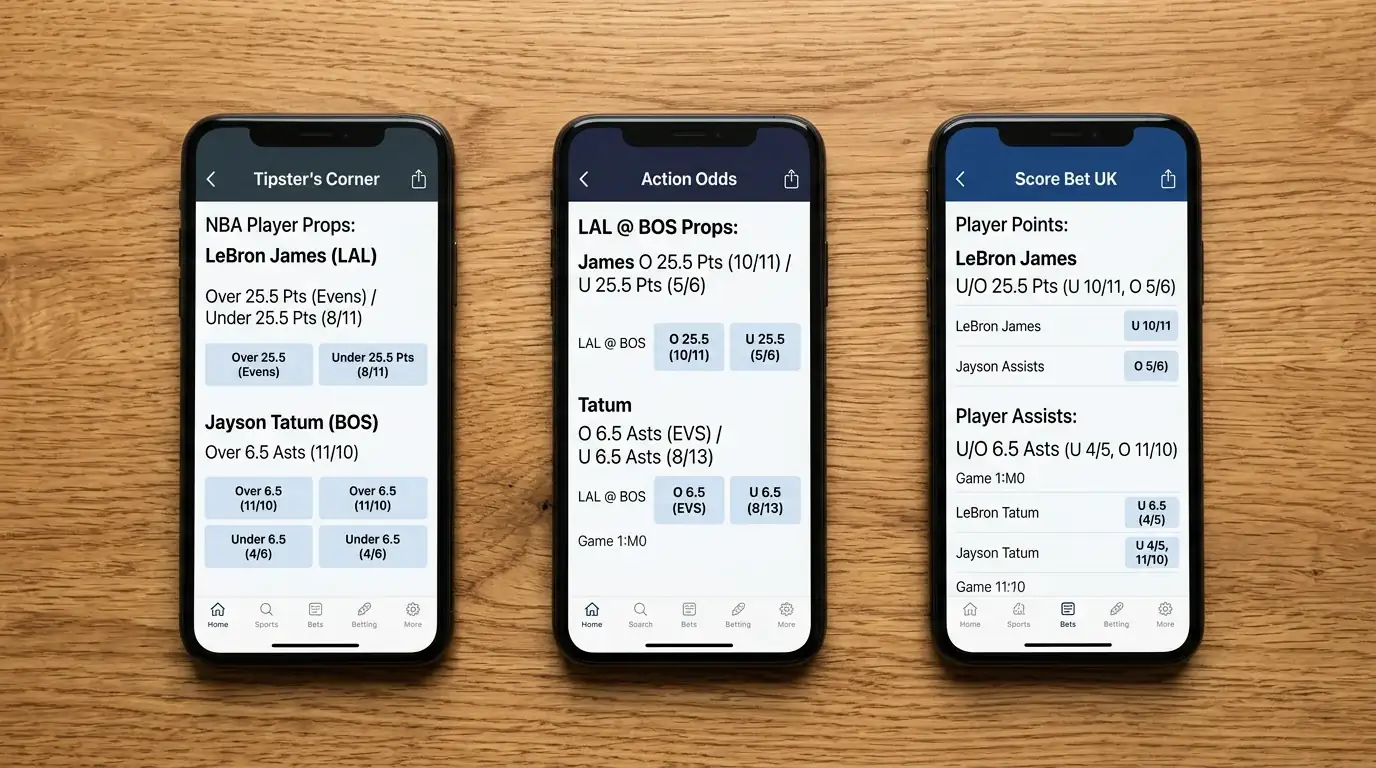
Every season I bet, I see the same thing across the UK NBA prop market: punters with sharp research who consistently bet at the worst available price. The line shopping habit is the cheapest edge in betting, the easiest to implement, and the most consistently neglected. A punter who places ten prop bets a week at the median UK price gives up an enormous fraction of his expected value to operators who happen to have the worst price in any given moment. The same punter who places those bets at the best available price across a few operators captures meaningful edge that compounds across the season into the difference between profit and loss.
Table of Contents
- The maths of price differences across operators
- The accounts portfolio that makes shopping practical
- The timing dimension that punters ignore
- The exchange option for sharp lines
- The restriction pattern that punters underweight
- The shopping workflow that works in practice
- The cumulative effect across an NBA season
The maths of price differences across operators
Different UK operators price the same prop at different odds because their internal models produce different probability estimates and their book balances differ. The variation is small on average — typically 3 to 5 per cent of the headline price — but it compounds across the season into a meaningful differential. A punter consistently betting at 1.95 when the best available price is 2.00 gives up roughly 2.5 per cent of expected value on every bet. Across 500 bets a season, that 2.5 per cent compounds into a meaningful annual figure.
The variation widens at the extremes of the line distribution. Headline lines — points, rebounds, assists for popular stars — tend to be priced tightly because operators converge their models on the highest-volume markets. The variation across operators on these lines is typically 2 to 3 per cent. Lower-volume markets — second-tier stars, niche props, alt lines — produce wider variation because the operator’s models have not been calibrated as precisely on the lower-volume data. Variation of 6 to 10 per cent on these lines is common, and the punter who shops these markets captures meaningful edge that the headline-line punter cannot.
The mechanics of the operator pricing system explain why variation persists. Each operator runs its own pricing algorithm with its own training data and its own risk parameters. The algorithms converge on tight markets because the volume forces convergence — when sharp action moves the line at one operator, the rest follow. On low-volume markets, sharp action does not concentrate enough at any single operator to drive convergence, and the prices drift independently for longer.
The accounts portfolio that makes shopping practical
Line shopping requires accounts at multiple operators, and the practical question is how many to maintain. Three to five accounts is the workable range for most UK punters. Two accounts is too few — you sometimes find both operators on the same side of the median, and the price improvement available is modest. Six or more accounts produces diminishing returns because the marginal price improvement from adding a sixth operator is small relative to the operational complexity of managing six relationships.
The selection of operators matters more than the number. The portfolio should include at least one operator from each major pricing camp — typically two operators that tend to lead the market on lines and three operators that tend to follow. The leading operators have sharper pricing on average but also tighter limits and faster restriction patterns; the following operators have looser pricing on average and slightly slower account management. The combination produces the best price coverage across the prop market.
Operating multiple accounts requires basic discipline that prop punters sometimes overlook. Account funding has to be tracked separately. Stake sizing has to account for the bankroll allocated to each operator. Withdrawal patterns have to fit within each operator’s verification framework. None of this is difficult, but it requires the kind of administrative attention that pure-research punters often resist. The payoff in long-run results justifies the operational overhead.
The timing dimension that punters ignore
Line shopping is not a one-shot activity at the moment of bet placement. Lines move across the day in patterns that produce timing-specific edges. Operators open lines at different times — some publish two days in advance, others publish on the morning of the game — and the early lines often have wider variation than the closing lines. Sharp action concentrates the prices toward closing-line consensus, but the journey from opening to closing offers windows where one operator’s price has not caught up to the market.
The most predictable timing pattern is the post-injury-news window. A star ruled out at noon for a 7pm tip-off triggers cascading line adjustments across his teammates’ props. The teammates’ lines move within minutes at the operators with sharp models; the slower operators take longer. The window between the news breaking and the slowest operator’s adjustment is typically 10 to 30 minutes, and the price improvement available during that window can be meaningful — sometimes 8 to 12 per cent better than the post-adjustment line.
The other systematic timing pattern is the late-evening lines refresh. Operators that update their pricing overnight sometimes do not refresh until the early afternoon, while operators that update continuously produce sharper morning lines. A morning research workflow that places bets at the slow-update operators captures the previous evening’s pricing on lines that have not refreshed for current market action. The window is short and the edges are small per bet, but the systematic application across the season compounds.
The exchange option for sharp lines
Betting exchanges offer a different kind of line-shopping opportunity. Exchange markets are user-driven — punters lay and back lines against each other rather than against an operator — and the resulting prices reflect collective market opinion rather than any single operator’s model. The commission structure typically charges 2 to 5 per cent on net winnings, and after commission the prices can be sharper or looser than fixed-odds operators depending on market depth.
For high-volume props on popular stars, exchange prices are sometimes the sharpest available because the market depth is high and arbitrage activity narrows the bid-ask spread. For low-volume props, exchange prices are sometimes much worse than fixed-odds because the market depth is too thin to attract liquid pricing. The punter who uses exchanges effectively chooses markets carefully — high-liquidity props for exchange play, lower-liquidity props for fixed-odds operators.
The other use of exchanges is laying. A punter who has identified an over-priced market can lay it on the exchange and capture the operator’s overround on the under side. This is sophisticated work that requires careful bankroll management, because lay positions carry materially larger downside than back positions. The reward, when it works, is some of the cleanest edges available in the prop market — but the operational complexity is meaningful.
The restriction pattern that punters underweight
Operators restrict accounts that consistently bet sharp prices. The restriction pattern matters for line shopping because the operators most useful for capturing price improvements are also the operators most likely to limit accounts that use them efficiently. A punter who systematically takes the best price across five operators will trigger restrictions at the sharpest operators within months, and the restrictions reduce the practical value of the multi-account portfolio.
The way to manage this is to balance staking patterns across operators rather than concentrating action at the operator with the best price each time. A punter who places 80 per cent of his action at the operator with the best price is going to be restricted quickly. A punter who balances his action across operators — taking the best price when the differential is large but otherwise distributing volume — extends his account longevity meaningfully.
The restriction signal is usually clear: stake limits drop, bonuses stop, certain markets become unavailable. When these signals appear, the operator’s restrictions are tightening and the value of the account is degrading. The right response is to redistribute action toward operators that are still treating the account normally, accepting slightly worse pricing in exchange for sustained access. The broader UK operator landscape shapes which restrictions tend to appear first and how aggressively each operator manages account behaviour.
The shopping workflow that works in practice
The practical line-shopping workflow does not require sophisticated tooling. The basic structure is straightforward: identify the prop bet through the research workflow, check the price at three to five operators, identify the best price, confirm the price has not moved during the check, place the bet at the best operator. The whole process takes two to three minutes per bet and produces 1 to 5 per cent expected value improvement per bet on average, depending on which markets are involved.
Mobile apps make this workflow practical for punters who are not at a desktop. A punter with five operator apps installed can switch between them quickly to check prices, and the friction is low enough that line shopping becomes a habit rather than an occasional activity. The work scales to whatever volume of betting the punter is doing — a punter placing five bets a week spends fifteen minutes a week on line shopping; a punter placing fifty bets a week spends two and a half hours a week on it. The expected value gain per hour spent is high in either case.
The discipline that this work requires is mostly procedural rather than analytical. The punter has to remember to check the prices every time. The punter has to honour the best-price logic even when the worst price is at his preferred operator. The punter has to track operator-specific behaviours and rotate accounts as needed. None of this is intellectually demanding, but it requires attention and consistency. The punters who do it routinely build a meaningful structural edge that complements their research work.
The cumulative effect across an NBA season
An NBA season produces 200-plus prop lines per match night across 1,230 regular-season games and 100-plus playoff games. The volume of pricing decisions a regular punter makes across this calendar is enormous, and the cumulative price differential between best and median pricing compounds into a substantial annual figure. A punter placing 500 bets a season at average stake size who captures even 2 per cent additional expected value through line shopping moves the bottom line meaningfully.
The 250,000 unique prop markets posted across the season are priced by a handful of major UK operators with materially different pricing models. The structural variation in their pricing approaches produces the line shopping opportunity, and the opportunity does not go away because operator models converge slowly on lower-volume markets. The same opportunity has been there for as long as the market has existed and it will be there as long as the market remains structured around independent operators competing for action.
The single biggest mistake I see in this space is punters who treat line shopping as an optional refinement rather than a foundational discipline. The research work that produces edge in this market is hard. The line shopping work that captures additional expected value on top of that research is easy. Skipping the easy work to focus on the hard work is a strange choice, and yet it is the choice most prop punters make. The punters who do both are the ones whose annual results consistently outpace their peers with similar research quality.
How many UK operator accounts do I need to make line shopping worthwhile?
Three to five is the practical range. Two is too few — you often find both operators on the same side of the median. Six or more produces diminishing returns because the marginal price improvement from each additional operator is small relative to the operational complexity. The selection should include at least one operator from each pricing camp — leaders that move first and followers that lag.
How quickly do operators restrict accounts that consistently bet best prices?
Sharp operators tend to restrict within months when an account systematically takes their best prices. The pattern is visible through stake limit drops and bonus disappearance. The way to extend account longevity is to balance action across operators rather than concentrate it at whichever operator has the best price each time. Restrictions are inevitable for sharp punters, but their timing can be managed.
Are betting exchanges generally better than fixed-odds operators for prop pricing?
It depends on the market liquidity. Exchanges produce sharper prices on high-volume props where market depth is high; they produce worse prices on low-volume props where depth is thin. The right approach is to use exchanges for liquid markets like star points and rebounds, and fixed-odds operators for less popular markets where exchange depth does not justify the commission cost.
Published by the nba Best Player Prop Bets team.