
Same-Game Parlay vs Bet Builder — UK and US Names for the Same NBA Tool
 Available in US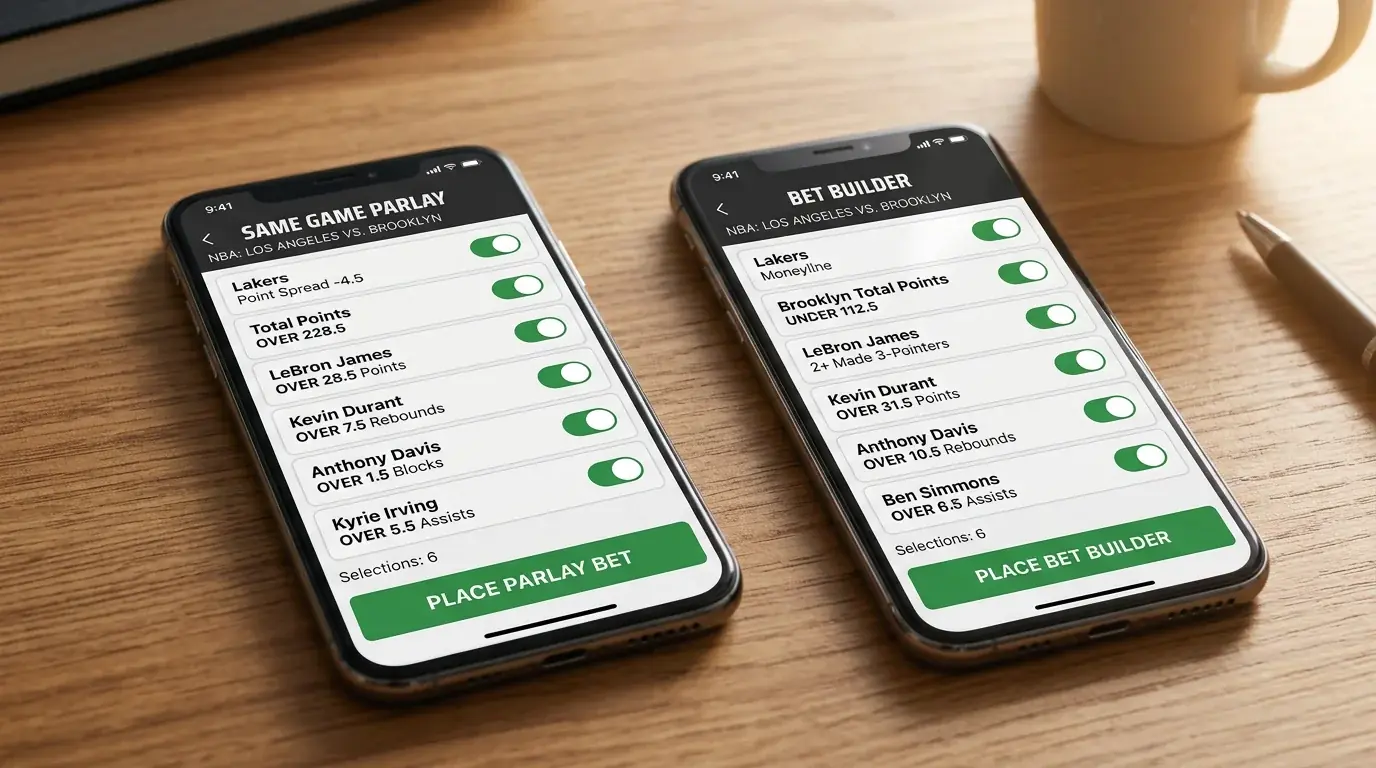
A friend of mine asked me last winter why his US-bred mate kept calling a UK bet builder a “parlay” and whether that meant the payouts were different. They are not. Same product, two names, different jurisdictions, and the small print is what tells you the rest. I have been combining NBA props on UK slips for a decade and I can tell you the terminology gap is the easy part. The pricing logic is what keeps catching even experienced punters out, and that is what I want to walk through here.
One product, two names — what the labels actually map to
On a US sportsbook the feature is called a same-game parlay, abbreviated SGP. On a UK bookmaker the same feature lives under “bet builder”, “request a bet”, or occasionally “your call” depending on the operator. Mechanically they do the same thing: combine multiple selections from the same game into a single ticket, with a combined price.
The translation is direct. A points-over plus a rebounds-over plus a threes-over on the same NBA player is a three-leg same-game parlay in the US and a three-leg bet builder in the UK. The slip looks different, the jargon is different, and the small-print rules vary by operator, but the underlying bet is identical: all legs must win or the ticket loses.
The popularity is identical too. Same-game parlays now form over 60 per cent of all bets in some US states, and at certain bookmakers up to half of all wagers fall into the prop-bet bucket. The UK is a few years behind on raw volume but trending the same direction. Bet builder is the gateway product through which most casual NBA punters in the UK now interact with player props at all, because building one ticket from a single game feels more intuitive than spreading bets across separate slips.
Correlation is the entire pricing puzzle
Here is the part that determines whether your bet builder is a value play or a sucker bet. NBA props on the same player are correlated — they move together — and the bookmaker has to decide how much credit to give that correlation when pricing the combined ticket.
Take a star ball-handler with three legs on him: over 28.5 points, over 6.5 assists, over 3.5 threes. Each individual line might price around 1.91. If you simply multiplied the decimals — 1.91 × 1.91 × 1.91 — you would get a parlay price of around 6.97. That is the price you would expect if the three outcomes were independent.
They are not independent. A night where the player exceeds his points line is heavily correlated with a night where he exceeds his three-point line, because most of his scoring comes from threes. Same player, same game, same hot shooting hand. The bookmaker knows this, and a sensible algorithm collapses the price down because the legs are not really three separate bets — they are one bet on “this player has a hot shooting night” wearing a three-leg disguise.
UK bet builders typically apply a correlation adjustment that reduces the multiplied price by 15 to 30 per cent depending on how strongly the legs are linked. Three high-correlation legs on the same player might price at 4.80 instead of 6.97. That sounds like a big haircut, and it is — but it reflects the reality that you are not really getting three independent shots at parlay glory.
The real pricing trap is the opposite case. When the bookmaker uses a generic correlation factor instead of a specific one, you sometimes find prices that are softer than they should be. The classic spot: a star’s points-over combined with the same star’s rebounds-over. These are weakly correlated for most modern guards (more shots usually means slightly fewer rebound chances on the offensive end, depending on the position) and the bookmaker often overcorrects, treating them as more correlated than they are. The combined price ends up higher than the true joint probability deserves. Books are often slower to react for player props than they are for sides and totals, partially due to bet limits and partially because props are mainly set by an algorithm, and informed punters with proper information beat the market consistently when the algorithm gets the correlation wrong.
The negatively correlated combination — where bet builders punish you
The opposite case is where bet builders punish casual punters. Combining one player’s points-over with a teammate’s points-over on the same team is sometimes negatively correlated — if the star takes 20 shots, the second option might only take 12. Not always, but often enough to matter. Bet builder algorithms occasionally treat this as independent and the combined price ends up worse than it should be. You are paying for a parlay that is mathematically harder to hit than the legs suggest in isolation.
How the UK bet builder actually behaves on the slip
Each UK bookmaker handles bet builder mechanics slightly differently, but the standard behaviour goes like this. You add a selection to the slip — say, a points-over on Jokić. The slip now shows a single bet at the price of that selection. You add a second selection from the same game — say, a rebounds-over on Jokić — and the slip combines them automatically into a bet builder, with a new combined price that reflects the operator’s correlation algorithm.
You can keep adding legs. Most UK books cap a bet builder at six to eight selections per game, although a few allow more for premium customers. The price compounds with each leg, but compounds at the correlation-adjusted rate, not the raw multiplied rate.
If a leg gets voided — for instance, a player suffers a late scratch and his prop is voided per the operator’s rules — the bet builder typically continues with the remaining legs at a recalculated price. This is one of the genuine advantages of bet builder over an old-style accumulator: a void leg does not kill the entire ticket. You will still want to read each operator’s specific void rules, which can vary on whether overtime counts and on what happens with a player playing fewer than a stated number of minutes.
Cash-out availability on bet builders is now standard at most UK books, and the cash-out price tracks the live in-play probability of all remaining legs cashing. The cash-out price always carries extra margin — usually three to five per cent on top of the standard vig — which makes it useful as a protection mechanism but rarely a profitable end state if you are betting against an efficient algorithm.
One quirk worth knowing. Some UK bookmakers will not allow certain combinations in the same bet builder. The most common block: a player’s over and the same player’s under on different stats are sometimes incompatible because the operator considers them too negatively correlated to price cleanly. If the slip refuses to combine a selection, that is usually why, not a system error. Knowing where to find the deepest selection of legs across operators sits inside the wider question of UK bookmaker coverage for NBA player props.
Cash-out, void rules and the pitfalls that bite
The biggest pitfall on bet builder tickets is forgetting how vig compounds. A six-leg bet builder might look like a glorious payout — 40-to-1, 60-to-1 — but if each leg carries five per cent overround and the correlation discount is modest, the cumulative house edge on a six-leg ticket can easily reach 25 per cent. That is brutal. Sustainable bet builder play means keeping leg counts low, choosing legs with genuine independent edges, and avoiding the temptation to pile on legs because the displayed price gets juicier.
The second pitfall is in-play cash-out. The cash-out price reflects the live probability of the remaining legs cashing minus the operator’s margin. Books charge extra vig on cash-out specifically because they know punters use it emotionally — they want out when a leg is sweating, and they will accept a worse price to escape the discomfort. The maths almost always says hold; the emotion almost always says cash. Pick one and stick to it.
The third pitfall is void treatment. Different operators treat early scratches and short-minute exits differently, and a leg you assumed was guaranteed to settle as a loss might void instead, changing the whole ticket’s structure. Always know the operator’s void window before you build.
Does the UK bet builder pay the same as a US same-game parlay?
The mechanics are the same: combine multiple selections from one game into one ticket with a correlation-adjusted price. The displayed odds will look different because UK bookmakers use decimal and US sportsbooks use American, but the underlying math runs identically. Specific operator rules on voids and minimum legs vary slightly between jurisdictions.
Why are some prop combinations blocked in UK bet builders?
Operators block combinations that are too strongly negatively correlated to price cleanly, or that create logical contradictions like an over and under on the same player and stat. The block is a pricing limitation, not a system error. If a slip refuses a combination, the bet builder algorithm has decided the legs cannot be combined within its risk model.
Prepared by the nba Best Player Prop Bets editorial staff.