NBA Player Prop Strategy — A Research Framework for UK Punters
 Available in US
Table of Contents
- The five-minute mistake that costs most punters their edge
- The five-factor checklist as a workflow
- Minutes and rotation — the foundation of everything
- Usage rate as predictor — the single most useful number
- Pace and possessions — the ceiling-setter
- Defence vs position — the matchup specifier
- No-vig probability math — the calculation that catches the trap
- Line shopping in the UK — practical mechanics
- Bankroll and staking — keeping the framework alive
The five-minute mistake that costs most punters their edge
The first time someone asked me how I picked NBA props, I tried to explain my workflow in a single sentence. It came out as: “I run minutes, usage, pace, matchup, and price.” That is technically true, and it is also useless as advice — it tells you the ingredients without showing you the recipe. So this guide is the recipe.
Here is the trap most punters fall into: they reverse the order. They pick a player they like, decide the line is wrong, and then look for evidence that confirms the bet. By the time they are checking minutes or usage, they have already committed emotionally. The framework I use does it the opposite way. I look at the slate without a target in mind, run each of the five factors as a filter, and let the bet emerge from the data rather than from instinct.
None of this is a system that prints money. Minutes, usage rate and matchup combined can shift expected statistical output by 20 to 30% in either direction on any given night, and that range is enormous — it is the gap between a high-confidence over and a high-confidence under on the same player. If your research catches the right side of that swing more often than the bookmaker’s margin lets the line drift, you have an edge. If it does not, you do not.
This is a UK-focused walkthrough. Decimal odds throughout. UKGC-licensed bookmaker conventions. The math underneath is universal, but the framing is for someone holding bet365 or Sky Bet open, not someone on FanDuel.
The five-factor checklist as a workflow
Let me lay out the whole framework in one place before we go deep on each piece. Five factors, in order: minutes, usage rate, pace, defence-vs-position, vig. Run them in that sequence, and a slate of forty potential bets reduces to four or five worth real attention.
Minutes first because nothing happens if the player is not on the floor. A 35-minute starter and a 22-minute bench guy have completely different probability distributions on every counting stat. If projected minutes are uncertain — usage role unclear, foul trouble likely, blowout risk — you skip to the next slate, no matter how attractive the line looks.
Usage rate second because it tells you what fraction of team possessions end through this player. A high-usage player on tight minutes can outproduce a low-usage player on heavy minutes, particularly on points and assists. Usage is the bridge between minutes and stat output.
Pace third because it sets the ceiling. Two teams running 105 possessions per 48 minutes generate more total counting stats — points, rebounds, assists, threes, the lot — than two teams running 95. The same player in a fast-paced matchup is not the same player in a slow one.
Defence-vs-position fourth because it tells you how much of that ceiling actually gets converted. A pace-up matchup against a top-three defence at the relevant position is a different bet from a pace-up matchup against a bottom-three defence.
Vig fifth because it tells you what you are paying to take the position. If your projection puts the player at 23 expected points and the line is 22.5, the over has theoretical value. After stripping vig, that value might be enough to bet, or it might be a coin flip. The math gets done last, and it gets done explicitly, not in your head.
The five-factor frame is sequential, not parallel. Each filter eliminates more candidates than the previous one, and by the time you get to vig, you should be evaluating two or three plays rather than twenty.
Minutes and rotation — the foundation of everything
Minutes are the single most predictive variable for NBA prop outcomes, and they are also the variable that punters most often guess at rather than research. The starting line — eight to twelve players running their typical roles — is stable on most nights. The deviations are where prop value lives, and they are usually visible in advance if you know where to look.
The first thing I check on a slate is the expected starter group. Confirmed starters get their typical minutes within a narrow range. A 35-minute-per-game starter will play 32 to 38 minutes on a typical night. A 28-minute-per-game wing will play 25 to 31. The standard deviation is real but contained. If the player is starting and the game is competitive, the minutes projection lands close to the season average.
The variance kicks in around four scenarios. Blowouts pull starter minutes down by 6 to 10 in the second half. Foul trouble can chop 4 to 8 minutes off any player who picks up two early. Back-to-back games shave 2 to 4 minutes off star load by design — coaches are managing fatigue, not just reacting to it. And the most important: rotation changes following an injury or a tactical adjustment can move minutes by 5 to 12 for the player absorbing the role.
The implication for prop bets is direct. A 30-minute player projected for 18 points needs to score at a rate of 0.6 points per minute to hit 18. If something compresses his minutes to 24, the same per-minute rate produces 14.4 points and the over fails by a wide margin. You did not need to be wrong about the player to lose the bet. You needed to be wrong about minutes.
This is why the injury report window matters as much as it does. The new 11:00 to 13:00 local-time injury report rule, with 15-minute updates after, is the cleanest read on minutes you can get pre-tip. Wait for it. Place your bet after, not before.
Usage rate as predictor — the single most useful number
If I had to pick one stat for prop research and discard the rest, I would keep usage rate. USG% is the percentage of team possessions ending through a specific player — through a shot attempt, a free throw trip, or a turnover. It is the cleanest measure of how central a player is to his team’s offensive output.
A high-usage star — Doncic, SGA, Brunson — typically runs USG% in the 30 to 35 range. A primary scorer averages 25 to 30. A solid contributor sits at 18 to 22. A pure spot-up shooter or defensive specialist drops below 15. The number tells you how to read every other stat the player produces.
For points, USG% is almost a direct multiplier. A player with USG% of 28 on 30 minutes of action will attempt roughly 17 to 20 shots, give or take, depending on offensive scheme. That shot volume produces a points distribution centred on a predictable mean. Drop the same player to USG% of 22 because a star returned from injury, and the shot volume drops accordingly. The points line should drop too, but bookmaker lines lag — that lag is your edge.
For assists, USG% has a more complicated relationship. High-usage scorers do not always have high assist rates; some are isolation-heavy and assist-light. But a high-usage primary playmaker — the player who runs the offence — has both a high USG% and a high assist rate. Watching the USG% of the secondary playmaker when the primary sits out is one of the most reliable assists prop angles in the game.
One US-based handicapper made the case for the prop market structurally. He argued that prop handle was hitting 40 to 50 percent of NBA volume in some states, and that on any given night you could have thousands of different player prop options instead of your traditional sides and totals. That breadth means the market cannot be sharp on every name. USG% changes — particularly when stars rest or return — are a major source of the lag, because books update lines slower than rotations actually shift.
The caveat is that USG% is a season-aggregate stat. A single game can deviate sharply from a player’s season USG% based on game state, foul trouble, or specific defensive matchups. Use season USG% as the baseline, then adjust for the specific scenario. A player whose season USG% is 24 might be running 30 in this specific game because his team is missing two creators. That single-night USG spike, with the line still priced for the season average, is exactly the kind of mismatch the framework is meant to catch.
Pace and possessions — the ceiling-setter
League-average NBA pace sits at roughly 100 possessions per 48 minutes, and that figure is the ceiling-setter for every counting-stat prop on the slate. A team running 105 generates 5% more possessions per game than a team running 100. Five percent does not sound like a lot until you realise it compounds across every stat the player produces.
The math is straightforward. If a player averages 1.2 points per possession his team uses while he is on the floor, and his team plays 70 possessions while he is on, he scores 84 points. If pace bumps to 75 possessions while he is on, he scores 90 — a six-point swing on the same per-possession rate. That swing happens before any other variable is in play.
What this means for prop research is that pace differential is a multiplier on every other factor. A high-USG player in a fast-paced matchup is a much more attractive over than the same player in a slow-paced matchup. The line typically moves with pace, but not always cleanly — particularly on counting stats other than points. Rebounds, blocks and three-pointers are pace-sensitive but priced more conservatively, which is part of why the hit rates on those markets sit higher than on points.
I check pace two ways. The first is each team’s season pace ranking, which tells me the baseline. The second is the matchup’s expected pace — when two fast teams play, the pace usually settles between their two season figures, often closer to the higher one. When a fast team plays a slow team, the slow team’s defensive scheme often dictates pace. A team that walks the ball up the floor compresses the pace of its opponent more reliably than a team that runs forces a slow opponent to run.
The pace lens also matters for the playoffs. Postseason pace drops by three to five possessions per 48 minutes from regular-season norms across the league, because playoff defences tighten and possession value rises. Counting-stat prop lines do not always adjust fully for that shift, and the early rounds of the playoffs are one of the more reliable windows for pace-based prop edges.
Defence vs position — the matchup specifier
Pace gives you the ceiling, defence-vs-position tells you how high the actual outcome lands inside that ceiling. DvP is a positional adjustment that ranks how much each NBA team gives up at each of the five positions, separately for points, rebounds, assists and so on. A team rated 28th in defence vs point guards is bleeding points to the position regardless of which point guard is playing tonight. A team rated 3rd in defence vs centres is choking off centre production regardless of who their starter is.
The strength of DvP is that it strips out the noise of which specific player is on the schedule. The weakness is that it is positional, not assignment-based. In modern NBA defences, switching is everywhere, and the player listed at point guard does not necessarily get the assignment most often. Top wing defenders draw the toughest perimeter assignments regardless of position. So you read DvP as a baseline, then adjust for known matchup tendencies.
Where DvP is most useful is identifying outlier matchups. A top-five player at his position going against a bottom-five defence at that position is a flag — the line is probably set close to season averages, and the matchup suggests a meaningful tilt above it. Bookmakers do adjust for matchups, but the adjustment is usually a partial one. The residual gap is the edge.
DvP works best on points and assists, where positional roles are most stable. It is messier on rebounds, where switching schemes and big-on-big assignments scramble the picture. It is least useful on blocks and steals, where the events are too rare to track meaningfully by position.
No-vig probability math — the calculation that catches the trap
Here is where most punters check out. Vig math feels like homework, and the temptation is to skip it and trust your gut. Do not skip it. Vig is the bookmaker’s margin, and ignoring it is the single most common reason hobby punters lose money even when their picks are good.
The starting position is a standard two-way prop priced at –110/–110 in American odds, which converts to roughly 1.91/1.91 in decimal. Implied probability per side is 1 divided by the decimal odds, so 1/1.91 = 0.524, or 52.4% per side. Add the two implied probabilities together and you get 104.76% — that 4.76% over 100 is the bookmaker’s overround, the margin baked into the price.
To strip the vig and get the no-vig probability, you divide each side’s implied probability by the total implied probability. So 0.524 / 1.0476 = 0.500, or 50%. That is the fair-price probability the bookmaker thinks each outcome carries, before margin. If your own projection of the over puts probability at 0.55, you have a 5-percentage-point edge over the no-vig fair price, and that edge is what you should be measuring.
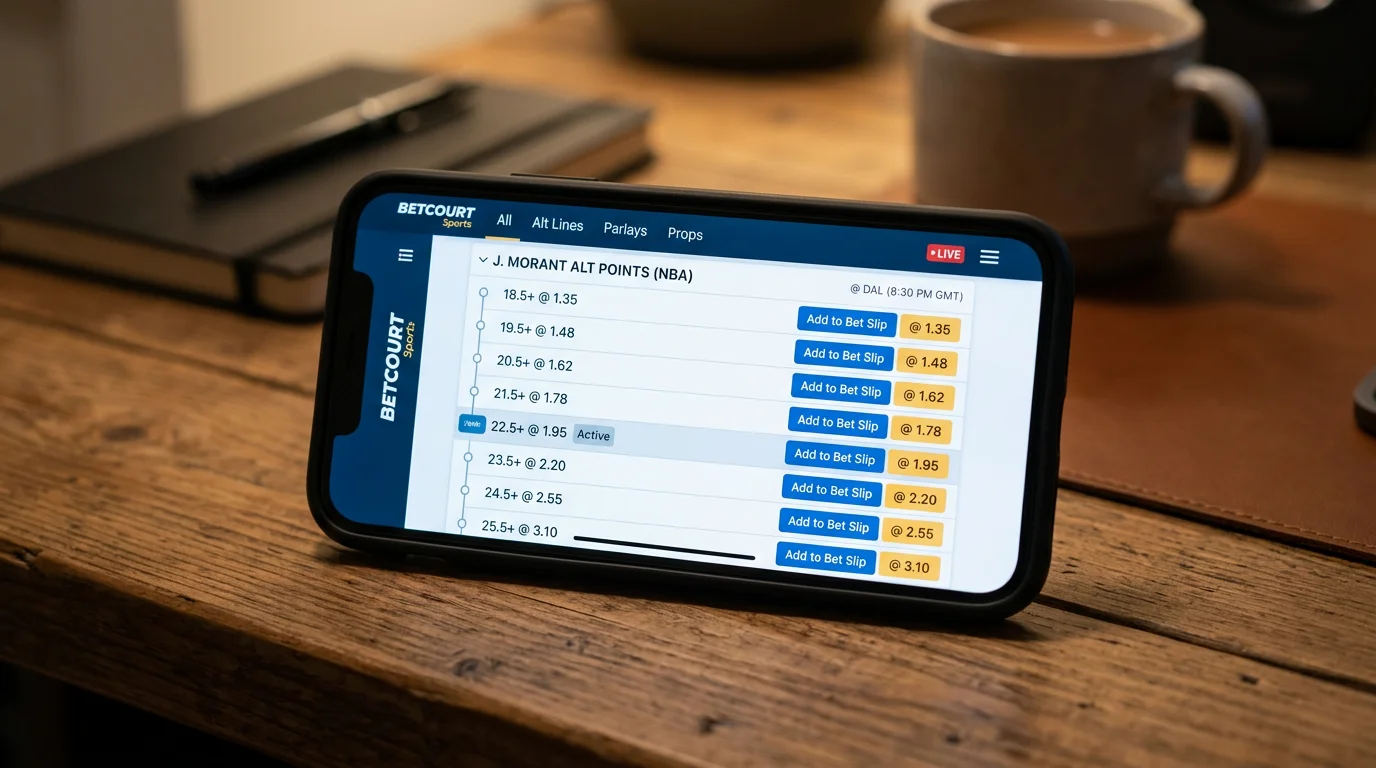
Where this gets interesting is on lines with shaded vig. A prop priced at 1.83 on one side and 2.00 on the other is not a balanced 4.76% overround book. The 1.83 side has implied probability of 0.546, the 2.00 side has 0.500, total is 1.046, overround 4.6%. Stripped, the no-vig probabilities are 0.522 and 0.478. The shading tells you where the bookmaker thinks the action is — the 1.83 side is the heavily backed one, and the price reflects it.
One US handicapper put the structural angle on books and prop pricing well. He observed that books are often slower to react for player props than they are for sides and totals, partially due to the limits on the amount you can bet on these props, and partly because props are mainly set by an algorithm or data and sports bettors can beat the market with proper information. The vig math is the clearest mechanical proof of that. If you can compute no-vig probability and compare it to your own projection, you are doing what most prop bettors are not.
If you want the worked-example version of this with actual numbers and step-by-step decimal-odds conversion, I built a separate piece on it. The no-vig probability guide covers the formula and a full case study.
Line shopping in the UK — practical mechanics
If your projection puts a player at 23 expected points and one bookmaker’s line is 22.5 at 1.91 while another’s is 22.5 at 1.95, the second bookmaker is paying you more for the same bet. Across hundreds of bets per season, that gap compounds into real money.
UK line shopping is more useful than people realise. The UKGC-licensed market has a handful of major brands — bet365, William Hill, Sky Bet, BetVictor, Paddy Power, Unibet, Betfair — and the lines are not identical. Differences of 0.5 on the prop line and 0.05 to 0.10 on the decimal odds are normal. On a single bet, that is small. Across a season of 200 bets, the punter who consistently takes the best available price clears materially more than the punter who bets at one book.
The mechanical question is how many accounts to maintain. My answer is three to five. Below three, you do not have enough alternatives. Above five, the operational overhead — separate KYC, separate deposit limits, separate tracking — outweighs the marginal price gain. Three accounts captures most of the price discovery; five is for someone treating prop research as a serious second income.
The discipline of line shopping is the part most punters skip. They open the bet builder on whichever site they happen to be logged into, and they take the line that is there. That habit is fine for casual betting and is exactly how the books make their margin. The serious punter checks at least two prices before committing.
Bankroll and staking — keeping the framework alive
Everything in this framework depends on the punter still being in business in three months. The fastest way to undo any edge you have is to stake too aggressively when conviction is high, lose a few in a row, and find yourself betting into recovery instead of into value.
The standard recommendation is flat stakes — every bet sized identically as a fixed percentage of your bankroll, typically 1 to 2%. That is conservative and durable. A more aggressive approach, used by punters with quantified projections, is fractional Kelly — staking proportionally to the size of the perceived edge. Kelly stakes can climb to 4 or 5% on high-conviction plays, and they scale down on coin-flip bets. The math is well documented but the discipline is hard.
The version of staking I actually recommend to readers is the simple one. Pick a stake size you can absorb losing 20 times in a row without changing your routine. Bet that stake. Do not chase. Do not double up after losses. Track every bet, including the ones you wish you had not made. Three months of disciplined data is worth more than three months of intuition, and it tells you whether your framework is actually working.
What is usage rate (USG%) and how does it map to prop projections?
Usage rate is the share of team possessions that end through a specific player while he is on the floor — through a shot, a free throw trip or a turnover. It maps almost directly onto points and assists prop projections because it tells you how often the player will touch the ball as a finisher. A high-USG player on heavy minutes is a different bet from a low-USG player on the same minutes, even when their season averages look similar.
How do I calculate the no-vig probability of an NBA prop line?
Convert each side’s decimal odds into implied probability by taking 1 divided by the decimal price. Add the two implied probabilities — the total will be over 100% by the bookmaker’s overround. Then divide each side’s implied probability by that total to strip out the margin. The result is the fair-price probability the bookmaker is implying once vig is removed, and it gives you a clean comparison point against your own projection.
Why does pace of play affect counting-stat props more than scoring averages?
Pace determines the total number of possessions a team uses in a game. Counting stats — points, rebounds, assists, threes — all scale with possessions. Scoring averages, particularly on a per-game basis, are a season aggregate that already includes pace effects, so they smooth out the variance. The single-game pace differential between two specific opponents on a specific night is what creates prop value, and that signal lives below the season-average level.
How much line movement justifies abandoning a planned prop bet?
If the line moves more than the equivalent of a meaningful change in your projection, the original edge is gone. As a rough rule, a 0.5 stat-point move on a counting-stat prop, or a 0.05 to 0.10 decimal odds move against you, is enough to invalidate a thin edge. If you would not place the bet at the new price as a fresh decision, you should not chase it from the old price.
Published by the nba Best Player Prop Bets team.