
No-Vig Probability — How to Strip the Bookmaker’s Margin From a Prop Line
 Available in US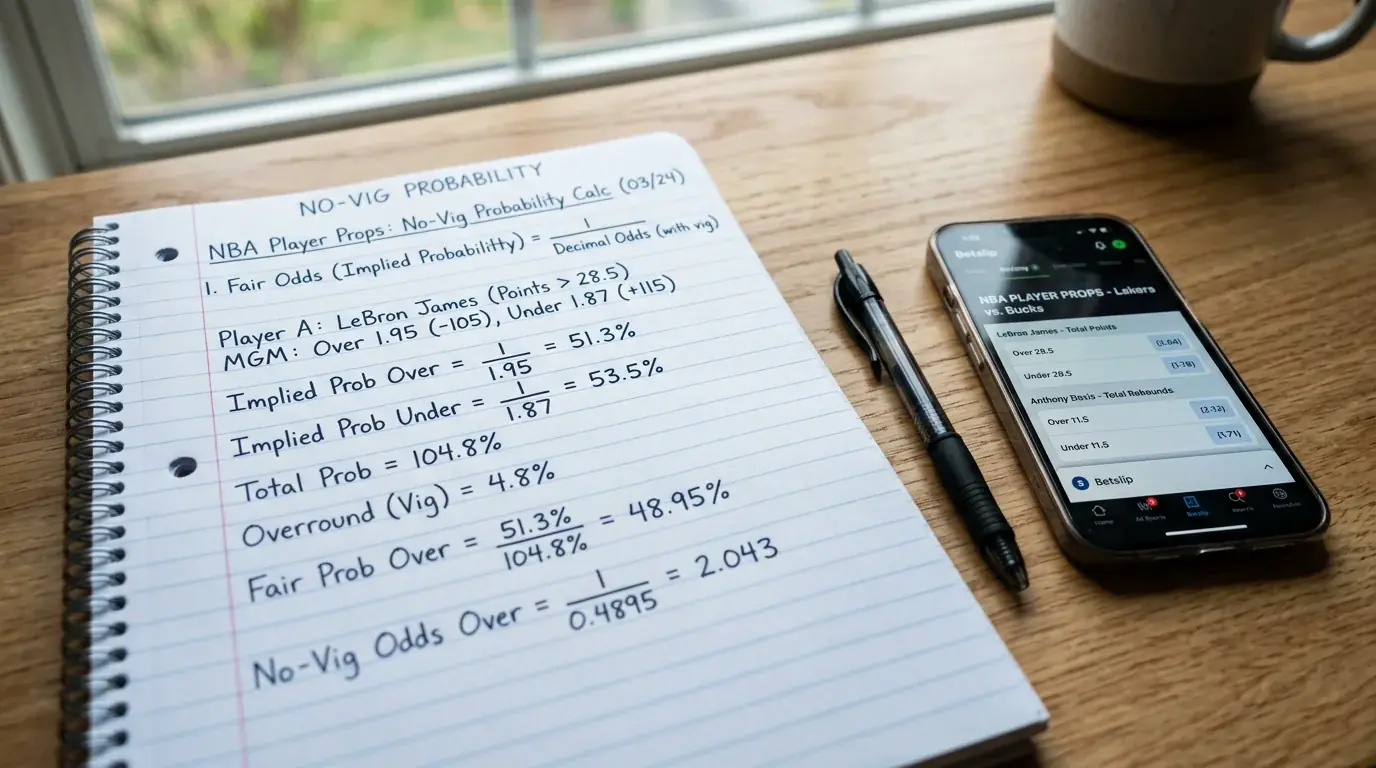
I keep a calculator on my desktop with one job: stripping vig out of every prop line I look at before I commit to a side. Twelve years into this and I still do it. Not because the math is hard — the math is trivial — but because the eye lies. A prop priced at 1.91/1.91 looks like a coin flip, and the moment you treat it as a coin flip you are already losing four and a half pence on every pound you stake. No-vig probability is how you stop the eye from lying to you.
What vig actually is, in decimal terms
The standard two-sided prop line on a UK bookmaker reads 1.91 over and 1.91 under, or thereabouts. That is the decimal-odds equivalent of the American –110/–110 you might see quoted in US data. Same line, different display.
If a coin had a true 50 per cent chance on each side, a fair bookmaker would price both sides at exactly 2.00. You stake one pound, you get two pounds back if you win, and the bookmaker breaks even over thousands of bets. The bookmaker does not break even — they take a cut. That cut is vig, also called juice, margin or overround.
The standard 1.91/1.91 prop carries a roughly 4.76 per cent overround. That number comes from converting both decimal odds to implied probability, summing them, and seeing how much the sum exceeds 100 per cent. At 1.91 each side, the implied probabilities are 52.36 and 52.36 — total of 104.72. The 4.72 above 100 is the bookmaker’s edge baked into the line.
Why does that matter? Because the bookmaker’s published probabilities do not represent what they actually think the chances are. They represent the chances plus a margin tilted toward house profit. If you want to compare your own projection to the line, you need to back out the margin and find out what the bookmaker truly thinks before they padded the price.
The formula, unpacked without the maths textbook
The no-vig formula in its simplest form: take each side’s implied probability, divide by the sum of both implied probabilities. The result is the no-vig probability.
For a 1.91/1.91 prop the math runs as follows. Implied probability of side A is 1 divided by 1.91, which is 0.5236, or 52.36 per cent. Same for side B, also 52.36 per cent. Sum is 104.72. Divide each side by 1.0472 to normalise to 100 per cent. You get 50 per cent on each side. So the bookmaker’s true read on a 1.91/1.91 prop is genuinely a coin flip — they just charge you 4.76 per cent for the privilege of placing the bet.
That works for a perfectly balanced prop. The interesting cases are unbalanced ones. Suppose you see Anthony Edwards’ points line at 28.5, with the over priced at 1.85 and the under at 1.95. Implied probabilities are 54.05 and 51.28. Sum is 105.33. Divide each by 1.0533 and you get 51.31 per cent on the over, 48.69 on the under. The bookmaker thinks the over is the more likely outcome, and they think it by about 2.6 percentage points after stripping their margin out.
Why bother with that calculation? Because if your own projection says the true over probability is 56 per cent, you have a four-point edge over the no-vig line. If your projection says 49 per cent, you should probably bet the under. Without the no-vig step, you would compare your 56 per cent to a posted 54 per cent and think the edge was tiny — when in fact it is closer to five points.
A worked example with two real-feeling decimal odds
Let me walk through a complete example. A primary playmaker has a points-and-assists prop posted on a UK bookmaker:
Over 32.5 priced at 2.05. Under 32.5 priced at 1.78.
Step one: convert to implied probability. Over implied is 1 divided by 2.05, which is 0.4878, or 48.78 per cent. Under implied is 1 divided by 1.78, which is 0.5618, or 56.18 per cent.
Step two: sum them. 48.78 plus 56.18 equals 104.96. Overround is 4.96 per cent — slightly above the standard 4.76 we saw on a balanced line, which makes sense because alternative-line and combined-stat markets carry a touch more margin.
Step three: normalise. Divide each implied probability by 1.0496. Over no-vig is 48.78 divided by 1.0496, which equals 46.47 per cent. Under no-vig is 56.18 divided by 1.0496, which equals 53.53 per cent.
The bookmaker’s true read: this player is more likely to fall under 32.5 combined points-and-assists than over, by about seven percentage points after margin removal.
Now your job is to project the player’s combined output independently. If your model says he averages 33.4 per night against this opponent type, with a standard deviation that puts his over-probability at, say, 53 per cent, you have a six-and-a-half point edge over the bookmaker’s no-vig read. That is the bet you take. If your model says 51 per cent, you have a smaller edge, but it still beats the no-vig line by enough to bet at proper stake. If your model says 47 per cent, you walk away or bet the under.
Notice what is happening. Without the no-vig step, you would have compared 53 per cent (your projection) to 48.78 per cent (the posted over implied) and thought you had a four-point edge. The real edge is six and a half. The vig hid roughly a third of your true advantage from your eye.
Using no-vig against your own projection
The no-vig probability is only as useful as the projection you compare it against. There is no point stripping vig out of a line if your own number is wrong. So once you have the no-vig figure on the screen, the next question is whether your model projection beats it by enough to justify a stake.
The threshold I use is around three percentage points. If my projected probability beats the no-vig probability by less than three points, I treat it as a marginal edge and either skip or bet small. Three to five points is a normal-stake spot. Five plus is where the larger units come out, with appropriate caveats around variance and bankroll. The reasoning behind that threshold is partly statistical — sample variance on a single projection is real and you need cushion — and partly practical: minutes, usage and matchup can collectively shift a player’s expected stat output by 20 to 30 per cent on any given night, which means even a strong projection has wide error bars.
Where the no-vig framework really earns its keep is over hundreds of bets. Edge-based stakes accumulate in a way that one-off picks cannot. Sportsbooks set most prop lines through algorithms and data feeds, which means the lines lag genuine information by minutes and sometimes hours, and informed punters with proper information beat the market consistently — but only when they actually price the line they are betting against, rather than betting on instinct. The discipline of running every prop through a no-vig conversion before you stake is the single biggest behavioural edge available to a UK punter, and it pairs naturally with the strategy framework where minutes and matchup do most of the projection work in our walkthrough on usage rate for prop bets.
What does a 4.76% overround mean in decimal odds?
It means the implied probabilities of both sides of the prop sum to 104.76 per cent rather than the true 100 per cent. The 4.76 above 100 is the bookmaker’s margin baked into the line, charged to you in the form of slightly worse odds than fair on whichever side you take.
Why does stripping vig matter if the bookmaker still pays the published odds?
Because comparing your own projection to the published implied probability gives you a distorted edge estimate. Vig hides roughly a third of your true advantage on a line where the bookmaker has a clear opinion, and it hides nearly all of your edge on a fairly balanced line. Stripping vig lets you see the bookmaker’s actual read and judge whether your projection beats it.
Written by the editors at nba Best Player Prop Bets.