Defense vs Position (DvP) — How to Read Matchup Numbers for Props
 Available in US
The first time I bet a points prop based purely on DvP I lost on a 28-point line because the player I had targeted spent the entire night being switched onto the opposing centre, who was nominally a power forward in the lineup data. The DvP page told me my guard would feast against a soft-perimeter defence. The actual matchup told me my guard would spend the whole game posted up by a 280-pound rim protector. DvP is a powerful tool. It is also the tool that punishes you most reliably when you read the surface and skip the structure underneath.
What DvP is and what the numbers actually represent
Defense vs Position is a normalised scoring statistic that measures how much production a defence allows to opposing players at each of the five positions. The standard ranking shows points (or rebounds, or assists) given up per game to point guards, shooting guards, small forwards, power forwards and centres separately. A team ranked first in DvP versus point guards is the toughest matchup on the slate for opposing point guards. A team ranked thirtieth is the softest.
The number behind the rank matters more than the rank itself. A defence allowing 24.1 points per game to opposing point guards is meaningfully softer than one allowing 21.7, even if the rank gap looks modest in the table. When you are trying to find prop value, focus on the raw allowance, not the ordinal position — DvP rankings get compressed at the extremes and the difference between rank 18 and rank 22 is often noise.
DvP normalises across position because positional production varies wildly. Centres average more rebounds than guards. Point guards average more assists than wings. Comparing a defence’s raw points-allowed total tells you nothing about whether their guard defence is good. DvP per position cuts through that.
Reading the numbers without falling into the surface trap
Here is where most punters misuse DvP. They open the table, see “DvP rank 28 versus shooting guards”, and conclude that any opposing shooting guard is a buy. That works maybe 60 per cent of the time. The other 40 per cent of the time the matchup is determined by individual assignments, switch coverage and double-team rules — none of which show up in the position table.
The first thing to do with a DvP number is figure out how stable the assignment will be. Modern NBA defences switch screens constantly, and a guard who shows up against a “soft point guard defence” might in practice spend half his on-court time matched against a defensive specialist who is officially listed as a power forward. The DvP page told you one story; the on-court coverage tells you another.
The second adjustment is recency. DvP based on full-season data is fine in March; it is misleading in November when only 12 games are in the sample. Always check the underlying number of games before you weight a DvP rank heavily. Twelve-game samples can swing by six positions in either direction across the next ten games.
The third adjustment is opponent quality. A team’s DvP versus point guards is partly a function of the point guards they have faced. A defence that has played five elite guards in its last ten games will look worse than its true talent because the schedule was harder; the same defence facing average guards next will likely outperform its DvP. Schedule context is rarely visible on the DvP page itself but matters every time.
Minutes, usage and matchup can collectively shift expected stat output by 20 to 30 per cent on any given night, and matchup is the leg of that triangle DvP is trying to capture. Capture, not predict — DvP is descriptive of the past, and the future depends on whether tonight’s coverage looks like the average coverage in the data.
How DvP holds up by stat type
DvP is not equally useful across every prop market. Some categories track to position-based defence cleanly. Others almost ignore it.
Points DvP is the most reliable, especially for guards and wings. The matchup-driven nature of perimeter scoring means that a soft defence at a position tends to surrender extra production consistently. The signal-to-noise ratio is high enough that a 25-position DvP gap between two opponents on consecutive nights translates to a roughly two-to-three point swing on a star’s projection.
Rebounds DvP is moderately useful, with a heavy positional caveat. Centres rebound against centres, but they also rebound against the opposing team’s shooting profile — a team that takes more threes generates more long rebounds, and long rebounds tend to land outside the painted area. A centre facing a high-volume three-point team often sees rebounds redistribute to wings, and his prop fades regardless of how soft the opposing centre rotation is on the boards.
Assists DvP is weak. Assist creation depends on the player’s own playmaking, the team’s offensive system, and the opposing defence’s pressure scheme. Knowing that a defence allows 7.8 assists per game to opposing point guards tells you something but not much, because that number is shaped more by pace and by the assist-makers the team has faced than by anything coverage-based. Use assist DvP as a tiebreaker, not as a primary input.
Blocks and steals DvP is almost useless. Block and steal totals are dominated by the defending player’s own ability and minutes, not by the opposing offence’s positional weakness. A 69.9 per cent hit rate on blocks props in graded data did not come from DvP analysis — it came from minutes, foul trouble and tip-rate research. If you are looking at a blocks prop, DvP belongs at the bottom of your input stack.
Three-point props track DvP at the team level — opponents allowing high three-point volume — better than at the position level. A wing facing a defence that lets opposing wings shoot freely is a soft matchup, but a wing facing a defence that surrenders threes to centres is not the same opportunity even if the headline DvP number looks similar.
The blind spots DvP cannot see
I keep a mental list of situations where DvP looks like it should help and does not. The list has saved me from more bad bets than any single positive read DvP has ever delivered.
Switch-heavy schemes break position assumptions. Teams that switch one through five effectively neutralise positional matchups for two-thirds of the offensive sets. The DvP table assumes positional integrity that the actual coverage does not respect.
Specific assignment overrides position. When a team has a defensive specialist who guards stars regardless of position — a wing-stopper who follows the opposing best perimeter player around — DvP at his nominal position becomes meaningless. Always check whether the opposing star will draw the specialist before you trust the position rank.
Garbage time inflates softness. A defence that gets blown out twice in the last week and surrenders 30 fourth-quarter points to the opposing bench will look worse on DvP than its starting unit deserves. Filter for non-garbage situations when possible.
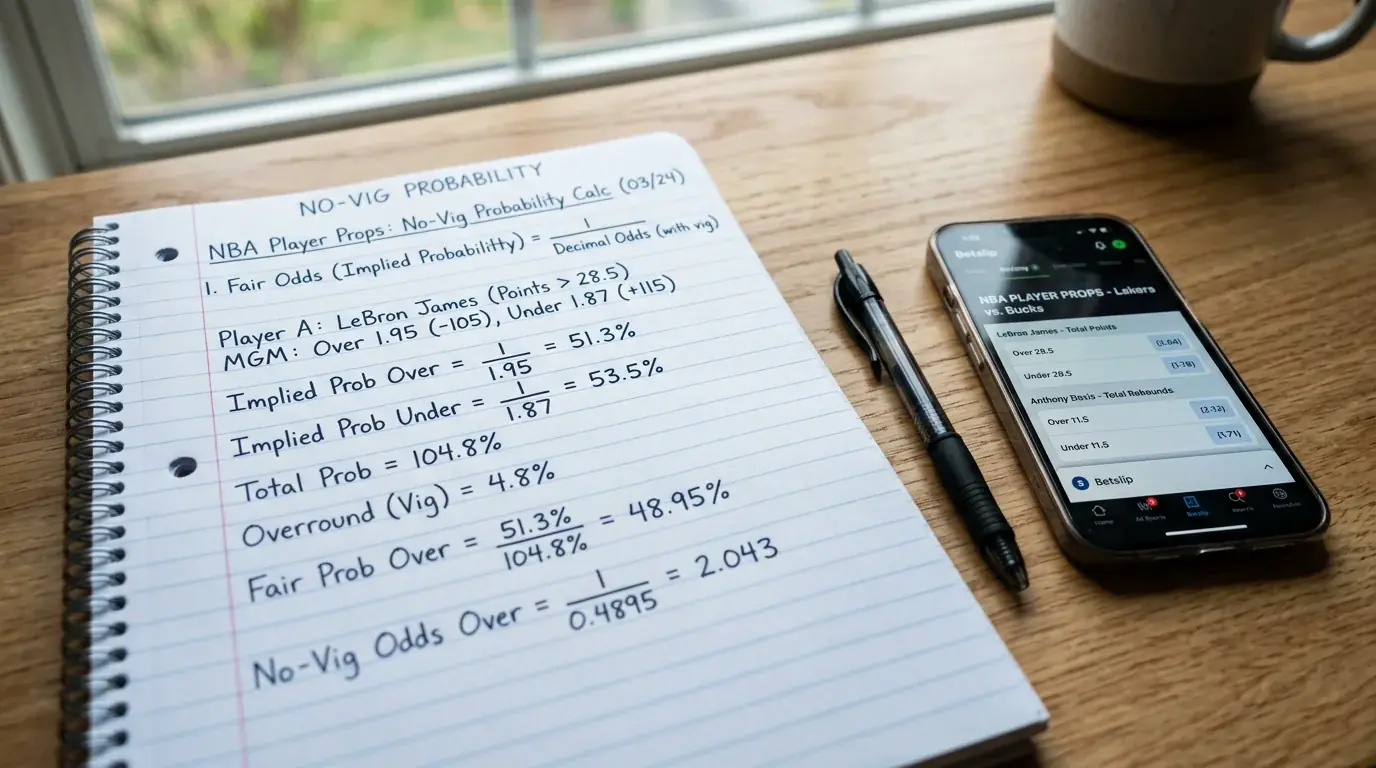
Defensive injuries reset everything. A team with a healthy starting wing defender has different DvP than the same team without him. The page does not always reflect last night’s news, and the books often update faster than the public DvP feeds. That asymmetry usually closes within a day, but it is a window worth watching, and once you have a feel for matchup quality the next layer is the math that strips bookmaker margin from the line — covered in our walkthrough on no-vig probability for NBA props.
Schedule fatigue compounds. A defence on the second night of a back-to-back surrenders more than its season-long DvP suggests. That is not a defensive personnel issue; it is a tired-legs issue, and the DvP page will not flag it for you.
Where do reliable DvP numbers come from?
Public NBA stat sites publish DvP by position with adjustments for pace and minutes. Look for sources that show the underlying games sampled and that filter for non-garbage situations. Aggregator sites that surface only the rank without the raw allowance number are less useful for serious research.
Should I use DvP for blocks and steals or only for points?
Use it for points first, rebounds second, three-pointers selectively, and almost never for blocks, steals or assists. Block and steal totals depend on the defender’s own minutes and ability rather than on opposing positional weakness. Assists depend more on pace and offensive system than on coverage.
Created by the ”nba Best Player Prop Bets” editorial team.